
Identify four specific environmental challenges
Identify four specific environmental challenges resulting from climate change using research from your textbook, and detail its four characteristics: geographic scope, key stakeholders, economic costs, and health impacts.
Summarize how climate change has worsened or created this environmental challenge, supporting your explanation with three references.
Compare the effectiveness of two mitigation efforts related to this environmental challenge.
Use at least four sources to support your writing. Choose sources that are credible, relevant, and appropriate.
Provide citations for each source listed on your source page at least one time within your assignment
This course requires the use of Strayer Writing Standards (SWS). The
library
is your home for SWS assistance, including citations and formatting. Please refer to the
Library site
for all support. For help with research, writing, and citation, access the library or review
library guides
. Check with your professor for any additional instructions.
Evaluate sources of environmental risk from energy production, manufacturing, and food production for their impact on population health.
Assess strategies used to mitigate the negative effects of environmental hazards on population health.
Global Climate Challenges: Health, Costs, and Mitigation Efforts

Introduction
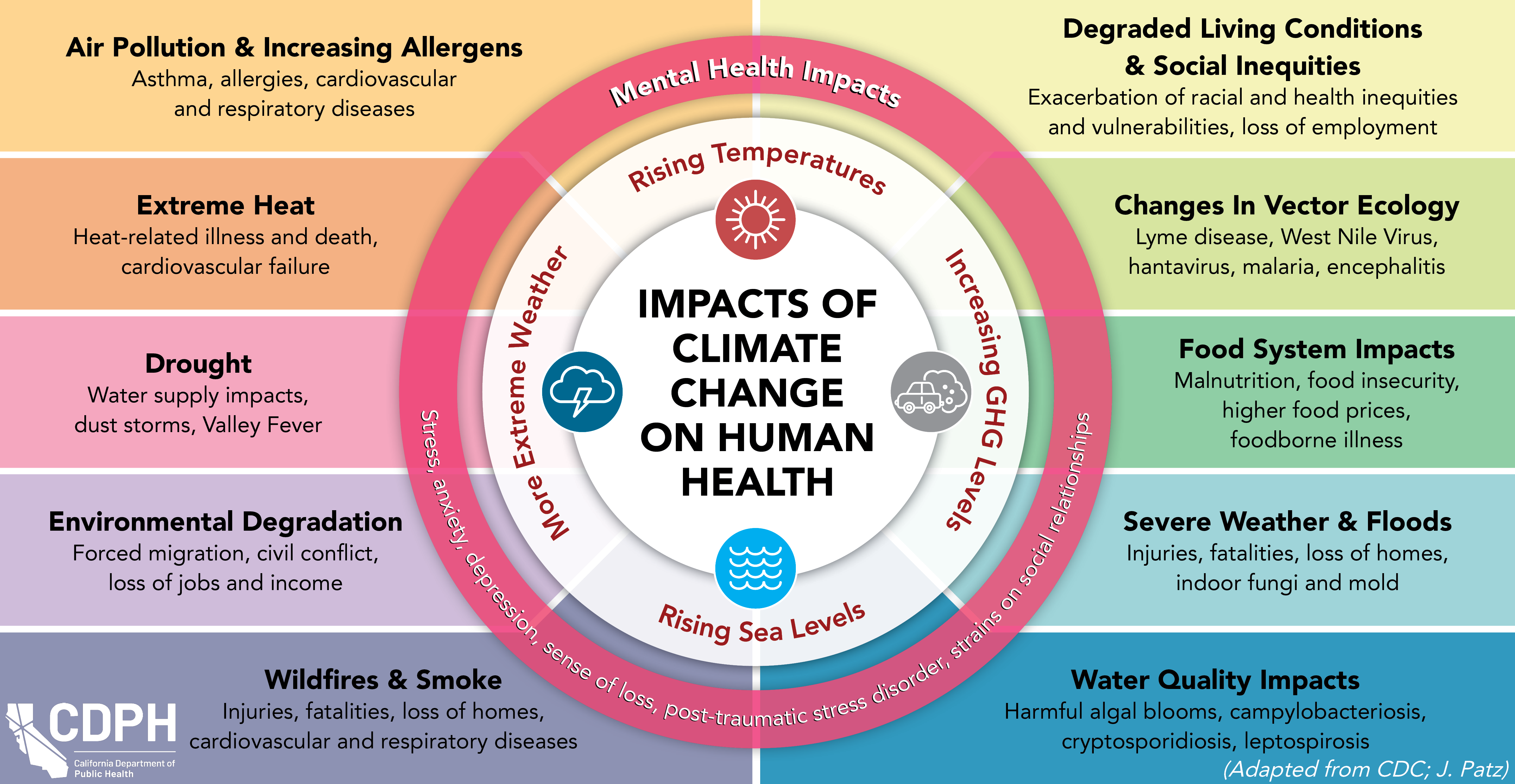
Climate change has accelerated a range of environmental challenges that affect ecosystems, human communities, and global health. Four major challenges—extreme heat, sea-level rise, air pollution, and declining food security—demonstrate the widespread and interconnected impacts of a warming planet. Each challenge contains specific characteristics including geographic scope, key stakeholders, economic costs, and health impacts. This paper identifies these challenges, explains how climate change has intensified them, compares mitigation strategies, and evaluates environmental risks from energy, manufacturing, and food production on population health.
1. Extreme Heat Events
Geographic Scope
Extreme heat waves now occur globally but are most severe in urban regions, the American Southwest, Southern Europe, and South Asia.
Key Stakeholders
Vulnerable groups include older adults, outdoor workers, low-income communities, and individuals with chronic illnesses.
Economic Costs
Extreme heat increases healthcare costs, reduces workforce productivity, strains energy systems, and contributes to infrastructure failures such as power outages.
Health Impacts
Heatstroke, dehydration, kidney failure, cardiovascular stress, and increased mortality rates occur during prolonged heat events.
2. Sea-Level Rise
Geographic Scope
Rising seas affect coastal regions, including Florida, Bangladesh, Pacific Islands, and major port cities worldwide.
Key Stakeholders
Coastal residents, local governments, real-estate markets, transportation sectors, and disaster-response agencies.
Economic Costs
Property loss, relocation expenses, coastal erosion, infrastructure damage, and higher insurance premiums arise from chronic flooding and storm surges.
Health Impacts
Contaminated drinking water, increased injuries from flooding, population displacement, and higher risk of mold-related respiratory issues.
3. Air Pollution Intensified by Climate Change
Geographic Scope
Air pollution worsened by rising temperatures and wildfire smoke affects North America, Europe, Australia, and much of Asia.
Key Stakeholders
Children, older adults, individuals with asthma or heart disease, and communities near industrial centers.
Economic Costs
Increased hospitalizations, lost workdays, crop damage, and heavy financial burdens related to wildfire suppression.
Health Impacts
Asthma attacks, chronic obstructive pulmonary disease (COPD), lung cancer, and cardiovascular disease are major health outcomes.
4. Declining Food Security
Geographic Scope
Food insecurity affects Sub-Saharan Africa, South Asia, Central America, and increasingly developed nations during droughts or supply disruptions.
Key Stakeholders
Farmers, food producers, consumers, governments, global supply-chain industries, and humanitarian organizations.
Economic Costs
Crop losses, livestock mortality, higher food prices, reduced export revenues, and increased government spending on relief programs.
Health Impacts
Malnutrition, weakened immune systems, micronutrient deficiencies, and increased childhood mortality.
Climate change acts as a multiplier, intensifying each environmental risk.
Extreme heat increases as greenhouse gases trap additional warmth in the atmosphere. According to the Intergovernmental Panel on Climate Change (IPCC), the frequency and duration of heatwaves have doubled in several regions, increasing heat-related deaths (IPCC, 2022).
Sea levels rise because melting glaciers and thermal expansion add water volume to oceans. Research from NASA shows that global sea levels have risen more than 8 inches since 1880, with nearly half occurring in the last 30 years (NASA, 2023).
Air pollution worsens due to higher temperatures accelerating ground-level ozone formation and wildfires releasing substantial particulate matter. Wildfire smoke events in 2020 and 2023 illustrate how climate-fueled fires generate hazardous air quality affecting millions (McCarty et al., 2021).
Food insecurity increases because drought, rising temperatures, and unpredictable rainfall reduce crop yields. The FAO notes major declines in wheat, maize, and rice crop productivity linked directly to climate stress (FAO, 2022).
These findings, supported by global research, confirm that climate change is a catalyst turning existing environmental issues into severe health and economic threats.
Two common mitigation strategies are renewable energy adoption and coastal adaptation infrastructure.
Renewable Energy Transition
Renewable energy reduces greenhouse gas emissions and lowers pollution. Solar and wind technology have significantly lowered costs, making them accessible substitutes for fossil fuels. This mitigation effort is highly effective in reducing emissions and improving air quality, directly benefiting public health.
Coastal Adaptation (Sea Walls, Wetland Restoration)
Adaptation strategies protect coastal communities from rising seas and storm surges. Sea walls offer immediate protection but require high maintenance and may harm natural ecosystems. Wetland restoration is ecologically beneficial, filtering pollutants and absorbing storm impacts, but requires long-term planning and land availability.
Effectiveness Comparison
Renewable energy offers greater global impact because it addresses the root cause of climate change—carbon emissions. Coastal adaptation is necessary but only protects specific regions and does not reduce climate warming. Thus, renewable energy is more effective as a long-term mitigation strategy, while coastal adaptation serves as essential localized protection.
Energy Production
Coal, oil, and gas operations emit particulate matter, sulfur dioxide, and nitrogen oxides, which contribute to respiratory illness, cancers, and cardiovascular disease. Fossil-fuel combustion also accelerates climate change, creating secondary health risks.
Manufacturing
Industrial facilities produce chemical runoff, heavy metals, and airborne toxins that disproportionately affect surrounding communities. Long-term exposure increases risks of asthma, neurological damage, and reproductive health issues.
Food Production
Pesticides, fertilizers, livestock waste, and methane emissions contribute to pollution and climate change. Industrial agriculture strains water systems, increases antibiotic resistance, and reduces ecosystem resilience.
Clean-energy transition, stricter emissions regulations, improved waste-management systems, and sustainable agriculture practices reduce environmental hazards. Strategies such as carbon pricing, electric public transit, regenerative farming, and industrial pollution controls significantly lower population health risks. Research supports that coordinated policy, community education, and investment in green infrastructure produce measurable health improvements and reduce climate-related disparities.
Environmental Protection Agency. (2023). Climate change and health effects. https://www.epa.gov
Food and Agriculture Organization. (2022). Climate impacts on agriculture. https://www.fao.org
Intergovernmental Panel on Climate Change. (2022). Sixth assessment report. https://www.ipcc.ch
McCarty, J., Smith, C., & Lassman, W. (2021). Wildfire smoke exposure and health outcomes. Environmental Research, 195, 110874.
NASA. (2023). Sea level change: Understanding rising oceans. https://sealevel.nasa.gov
National Oceanic and Atmospheric Administration. (2023). Climate data records. https://www.noaa.gov
Smith, K. R., & Ebi, K. (2019). Climate change and population health. Annual Review of Public Health, 40, 263–283.
World Health Organization. (2023). Climate risks and human health. https://www.who.int
World Resources Institute. (2022). Climate mitigation strategies. https://www.wri.org
Zhang, Q., & Chen, Y. (2020). Economic impacts of climate-related environmental hazards. Journal of Environmental Economics, 48(2), 201–217.